


What is the Difference Between AC and DC Power?Every modern electrical device runs on Alternating Current (AC), Direct Current (DC), or a hybrid combination of both. To properly select chargers, inverters, and battery-based power systems for home, RV, marine and solar applications, you need to understand their definitions, generation principles, calculation rules, practical differences and conversion logic. This article breaks down AC and DC power with technical depth and real-world examples.
- Part1: What Is AC Power and DC Power?
- Part2: The Differences Between AC VS DC Power
- Part3: How Do You Know AC Power or DC Power?
- Part4: Why Have AC and DC Two Power Types?
- Part5: How Are AC Power and DC Power Converted?
- Part6: AC VS DC Power in RV, Marine and Solar
- Conclusion: Which is Better, AC or DC Power?
- FAQs About AC and DC Power Supply
Part1: What Is AC Power and DC Power?

What Is AC Power?
Definition: Alternating Current (AC) is an electric current whose voltage and electron flow periodically reverse polarity and direction over time.
Waveform: Standard grid-grade AC presents a smooth sinusoidal sine-wave waveform, oscillating between positive and negative voltage values. Other waveforms include square-wave (A more affordable waveform that works with basic appliances but may cause noise, heat, or reduced efficiency with sensitive devices.) and modified-sine-wave (The simplest and lowest-cost waveform, but with poor compatibility and rarely used for modern electronic equipment.) generated by low-cost inverters.
How it is generated: AC is mainly produced by an alternator (AC generator). A wire coil spins inside a fixed magnetic field driven by steam, water, wind or fuel engines. Per Faraday’s law of electromagnetic induction, rotating coils cutting magnetic-field lines induce alternating voltage output. Slip-rings and carbon brushes transfer power from rotating coils to external circuits without rectification, naturally generating bidirectional current flow.
Working principle: As the coil completes one full mechanical rotation, the current finishes one full electrical cycle. Rotation speed determines frequency measured in Hertz (Hz): cycles per second. North America uses 60 Hz; Europe, Australia and most Asian regions adopt 50 Hz.
Calculation method:
- Instantaneous voltage formula for sine-wave AC:v(t)=Vpeak×sin(2πft)
- RMS (Root-Mean-Square) effective value:VRMS=Vpeak/√2. Household rated voltage such as 120 V or 240 V refers to RMS value, not peak voltage.
- Single-phase AC power:P=VRMS×IRMS×PF;PF means power factor.
Application scenarios & concrete examples:
- Utility-scale long-distance power transmission via overhead high-voltage power lines;
- Household wall outlets, refrigerators, washing machines, air-conditioners, microwave ovens and lighting fixtures that plug directly into mains power;
- Commercial factory machinery, three-phase industrial motors and large-scale electrical equipment.
What Is DC Power?
Definition: Direct Current (DC) maintains fixed voltage polarity, with electric charge flowing consistently in one single direction from positive terminal to negative terminal.
Waveform: Ideal DC shows a flat horizontal straight line on voltage-time plot. Practical DC from adapters or solar panels contains minor ripple noise instead of perfectly flat output.
How it is generated: Two major natural sources:
- Chemical batteries: Electrochemical reactions inside lithium-ion, LiFePO4 or lead-acid batteries create stable fixed-polarity potential difference between positive and negative electrodes, outputting DC power directly.
- Photovoltaic solar panels: The photovoltaic effect converts sunlight photon energy directly into unidirectional DC electric current. Additionally, DC can be artificially converted from AC power through rectifier circuits (chargers, adapters).
Working principle: Charge carriers flow continuously toward one direction with no periodic polarity flip. There is no “cycle” or frequency concept for DC power.
Calculation method:
- DC power formula:P=V×I. No power-factor correction is required for pure DC resistive loads. Voltage and current values are stable constant readings without RMS conversion.
Application scenarios & concrete examples:
- All types of batteries: power banks, 12 V vehicle batteries, home energy-storage battery banks;
- Consumer electronics internal circuits: smartphones, laptops, routers, LED drivers (the devices plug into AC wall sockets yet run internally on DC);
- Off-grid solar systems, electric-vehicle high-voltage battery packs, USB-powered gadgets, DC water pumps and DC cabin lights for RVs.
Part2: The Differences Between AC VS DC Power
| Comparison Item | AC (Alternating Current) | DC (Direct Current) |
|---|---|---|
| Current Direction | Periodically reverses back-and-forth | Single fixed direction |
| Typical Waveform | Sinusoidal sine wave | Flat stable line (small ripples in real-world hardware) |
| Frequency | Defined value: 50 Hz / 60 Hz | No frequency (0 Hz) |
| Core Generation Equipment | Alternator / AC generator | Batteries, solar PV panels; also rectified from AC |
| Voltage Adjustment | Simple & low-cost via transformers | Needs DC-DC converter hardware |
| Energy Storage | Cannot be directly stored; must be rectified to DC first | Can be chemically stored inside batteries |
| Power Calculation | Needs RMS value and power-factor correction | Direct multiplication of voltage × current |
| Conversion Devices | AC-to-DC: Rectifiers, chargers, AC adapters | DC-to-AC: Inverters |
| Representative Sources | Wall outlets, power-grid generators | Batteries, USB ports, solar panels |
Advantages of AC Power
- Outstanding performance for long-distance power transmission. AC can be boosted to ultra-high voltage for transmission, reducing transmission current and resistive heat loss; then stepped-down safely for end-users by transformers.
- Mature, low-cost hardware for residential, commercial and industrial large-scale power distribution.
- Most traditional household appliances and AC motors can operate directly from AC mains without extra conversion modules.
Disadvantages of AC Power
- Semiconductor-based electronics cannot work with raw AC input. Rectification brings conversion heat loss and adds component costs.
- Cannot be stored directly. AC power must be converted to DC before charging any battery bank.
- Harmonic noise and frequency deviation may interfere with precision sensors, medical instruments and audio-visual equipment.
Advantages of DC Power
- Delivers stable, low-noise voltage perfectly matching modern semiconductor-based electronic circuits.
- Native energy-storage capability, supporting portable devices, backup power and off-grid power systems.
- Voltage and current are easy to monitor and regulate, simplifying battery charge management and BMS protection logic.
Disadvantages of DC Power
- Voltage lifting or reduction requires dedicated DC-DC converters, which increase system complexity, cost and power waste.
- High-power DC short-circuit faults produce huge fault currents, which may overheat cables and permanently destroy components; robust protection circuits are mandatory.
- Conventional household AC appliances cannot run directly from DC power, requiring inverters with associated conversion losses.
Part3: How Do You Know AC Power or DC Power?
In daily maintenance, equipment selection and wiring work, three practical approaches help you reliably distinguish AC and DC power sources.
Judge by power-source origin: Wall sockets, grid-connected generators output AC. Batteries, power banks, USB interfaces, car cigarette-lighter ports and solar panels produce DC. Note: most commercial “AC adapters” accept AC wall input but deliver regulated DC output for electronic gadgets.
Check printed symbols and specification labels on hardware:
- AC symbol: wavy tilde ~ (marked as V~ / A~)
- DC symbol: solid-and-dashed horizontal line ⎓ (marked as V⎓ / A⎓)
Always read both input and output specifications on chargers and adapters. The name “AC adapter” only describes its mains input type, and its output is almost always DC. Many users mistakenly purchase unsuitable power supplies by only reading product names without checking output markings.
Measurement with digital multimeter
- Switch dial to V~ position for AC-voltage testing (wall outlets, generators).
- Switch dial to V⎓ position for DC-voltage testing (batteries, solar panels, circuit boards).
Safety note: Select the correct measurement mode. Testing high-voltage AC under DC mode returns meaningless readings and risks damaging measuring instruments. Use CAT-rated insulated probes when measuring mains-level high-voltage power.
Part4: Why Have AC and DC Two Power Types?
The coexistence of AC and DC originates from the well-known “War of the Currents” at the end of 19th century, alongside modern-day practical engineering realities.
Thomas Edison promoted early DC power systems. At that time, DC generators supplied residential lighting. However, DC lacked simple, low-cost voltage-transformation solutions. Transmission distance was extremely limited; power stations had to be built within a few kilometres of end-users, which could not support large-area city-wide power supply.
Nikola Tesla developed AC generator and transformer technology. AC could be easily stepped-up for long-distance transmission and stepped-down for household use, drastically cutting infrastructure investment. George Westinghouse commercialized Tesla’s AC system, and AC gradually became the backbone of global public power grids.
Nevertheless, DC was never eliminated. Battery chemical reactions and solar photovoltaic cells inherently produce DC. All modern microchips, LED lighting and electric vehicles rely on stable DC to operate correctly.
Today’s real-world power infrastructure is hybrid by design. Public grids transmit AC; chargers convert AC to DC for electronics and battery charging; inverters convert stored DC back to AC to drive traditional household appliances. Neither AC nor DC fully replaces the other.
Part5: How Are AC Power and DC Power Converted?
Bidirectional conversion bridges the gap between grid supply, energy-storage batteries and end-user appliances. Every conversion process inevitably creates thermal power loss and requires reliable protective hardware.
AC-to-DC Conversion (Rectification)
Core scenario: Household wall-socket AC cannot directly power lithium batteries or electronic circuit boards. This conversion is used when you charge smartphones, laptops and lithium-iron-phosphate batteries from mains outlets.
Implementation method: Completed by rectifier circuits built inside chargers and AC adapters. The hardware transforms alternating-current input, filters waveform ripples and outputs stable regulated DC voltage.
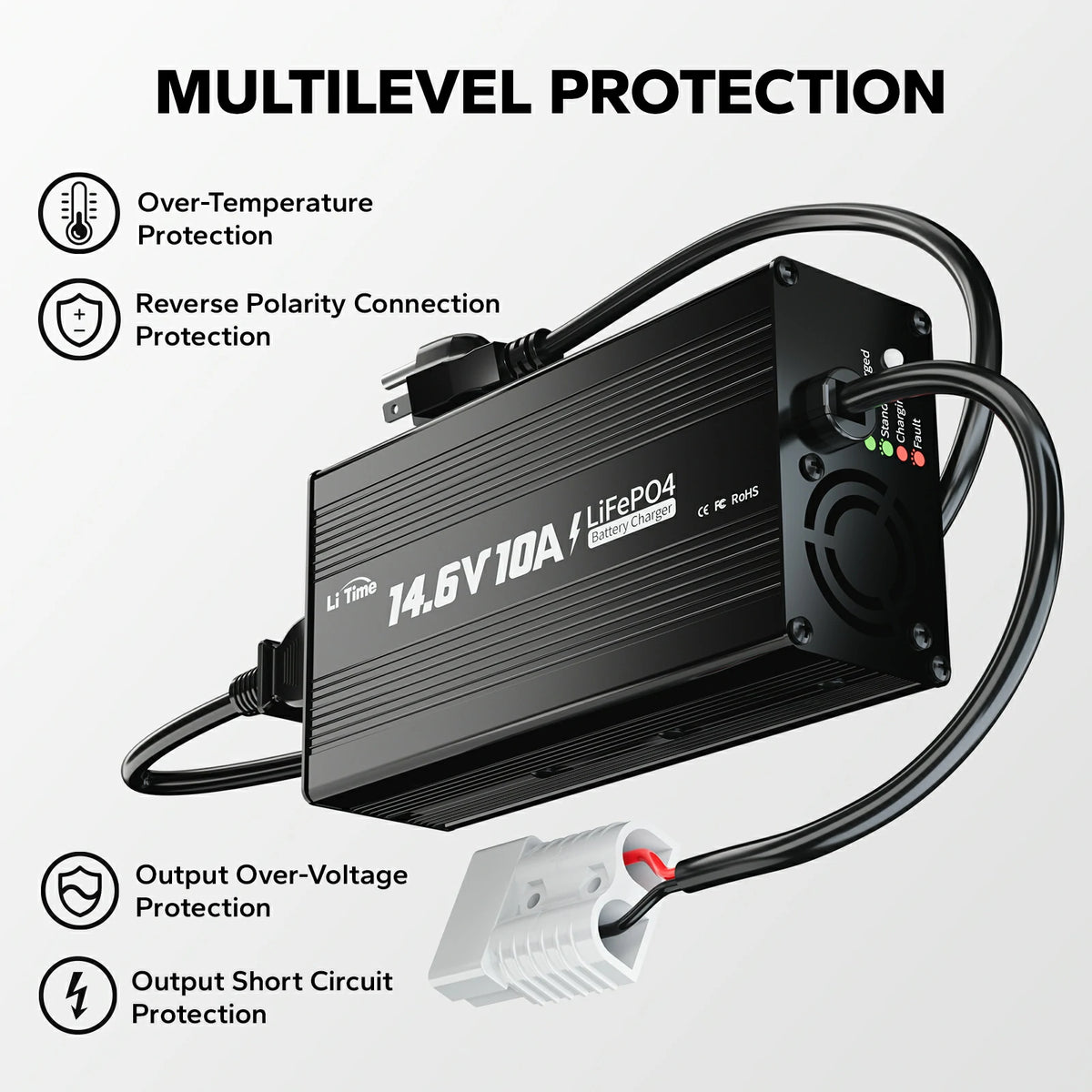
For instance, USB chargers convert 120 V/240 V AC into 5 V DC for mobile phones; dedicated LiFePO4 battery chargers convert mains AC to 14.6 V DC for battery charging.
DC-to-AC Conversion (Inversion)
Core scenario: Batteries and solar panels output DC power, but most household-grade appliances are designed for grid-standard AC input.
Implementation method: Realized by inverters. Two main types are widely available:
- Pure sine wave inverters: Generate smooth grid-compatible sine-wave AC with low harmonic distortion. Safe for refrigeration compressors, air-conditioners, medical equipment and sensitive audiovisual electronics, recommended for RV, marine and primary off-grid systems.
- Modified sine wave inverters: Output stepped block-form waveforms. Low-cost option, but may trigger motor overheating, audible hum or digital-device malfunction; fit only for simple resistive loads such as incandescent lamps and heating devices.
Critical practical notes for conversion hardware selection:
- Distinguish continuous rated wattage and peak surge capacity. Motor-driven loads like refrigerators draw large inrush startup current; the inverter’s surge rating must handle transient peak load.
- Conversion efficiency never reaches 100%. Heat generation is unavoidable; maintain sufficient ventilation space for inverters and chargers.
- Always select certified products with complete built-in protection circuits.

Part6: AC VS DC Power in RV, Marine and Solar
RV, marine vessel and off-grid solar installations operate as hybrid AC-DC ecosystems combining DC generation, battery storage and AC-type household loads.
RV Application
Most RV basic electrical buses run on 12 V or 24 V DC. Solar panels mounted on the roof produce DC power. An MPPT charge controller regulates DC current to charge onboard lithium or lead-acid battery banks. DC loads including cabin LED lights, water pumps and DC refrigerators draw power directly from batteries without conversion loss.
When the RV connects to shore-power campsite sockets, incoming AC power goes through an inverter-charger unit: AC is rectified to DC to recharge batteries. While boondocking off-grid, an inverter converts battery DC to 120 V / 240 V AC to run microwaves, air-conditioners and other conventional appliances.
Marine (Boat / Yacht) Application
Marine systems mostly adopt 12 V or 24 V DC bus architecture. Batteries supply DC for navigation lights, bilge pumps, communication radios and onboard instruments.
When docked at harbour shore-power, AC shore supply charges battery banks. While sailing offshore, inverters convert battery DC into AC to power household-style kitchen and living-zone appliances.
Special reminder for marine setups: select marine-grade corrosion-resistant wiring and hardware to resist salt-air and high-humidity environment.
Solar + Battery-Storage System
Solar panels generate raw DC power from sunlight. The MPPT charge controller optimizes DC output and charges battery banks. Batteries store energy in DC form.
- For off-grid solar systems: inverters convert stored DC into household-grade AC for domestic appliances.
- For grid-tied solar systems: hybrid inverters transform solar-generated DC to grid-synchronized AC.
General optimization tip for RV / marine / solar projects: Prioritize DC-powered appliances wherever possible to avoid DC-AC-DC round-trip conversion losses and extend available battery runtime.
Conclusion: Which is Better, AC or DC Power?
There is no absolute “better” between AC power and DC power. Each technology is engineered to solve distinct engineering requirements.
- AC power excels at large-scale long-distance energy transmission and operating legacy household and industrial AC-motor-driven equipment.
- DC power delivers superior performance for chemical-based energy storage, solar-power generation and running modern semiconductor-based consumer electronics.
Real-world modern power systems leverage both power types in coordination. Grid-supplied power arrives as AC; devices convert AC to DC for internal circuits and battery charging; inverters transform stored DC back to AC for traditional appliances.
FAQs About AC and DC Power Supply
Is house power AC or DC?
Electricity delivered to household wall outlets is AC. Lights, refrigerators and washing-machine motors run directly on grid AC. However, smartphones, laptops, Wi-Fi routers and televisions operate internally on DC.
Why is DC not used in homes?
Primary limiting factors are historical legacy and massive existing infrastructure investment. AC transformers enabled affordable long-distance power distribution, so the whole global power grid was built around AC standards.
Is a lithium battery AC or DC?
All lithium-ion and LiFePO4 lithium batteries store and release DC power. Internal electrochemical reactions produce single-direction current flow.
Is 240V power AC or DC?
Standard residential 240 V wall-outlet power is AC. High-Voltage Direct-Current (HVDC) transmission lines exist for utility-scale long-distance power transport, yet consumer-facing 240 V household sockets deliver alternating-current power.
Is a car battery AC or DC?
Vehicle starter and house batteries supply 12 V DC. All factory-installed onboard vehicle electronics run from DC. If you want to run standard AC household appliances inside a vehicle, install a car inverter to convert battery DC to AC.
Read More: Is a Car Battery AC or DC?

