You have two 12V batteries. Should you wire them in series to power 24V equipment, or in parallel to keep a 12V system running longer?
If you are comparing 12V batteries in parallel vs series, this guide explains wiring 12V batteries in series vs parallel, how to pick a charger, and what setup fits your RV, boat, or golf cart.
- 12V Batteries in Series vs Parallel: Voltage and Capacity
- How to Wire 12V Batteries in Series or Parallel
- 12V Batteries in Series vs Parallel for RVs, Boats, and Golf Carts
- How to Charge 12V Batteries in Series vs Parallel
- How Many 12V Batteries Can You Connect in Series or Parallel?
- FAQs About 12V Batteries in Series vs Parallel
12V Batteries in Series vs Parallel: Voltage and Capacity
Series adds voltage. Parallel adds amp-hour capacity. If you compare 2 12V batteries in series vs parallel, the table below shows what changes when both batteries have the same ratings.
| With two 12V 100Ah batteries | Series | Parallel |
|---|---|---|
| Bank voltage | 25.6V | 12.8V |
| Bank capacity | 100Ah | 200Ah |
| Stored energy | 2,560Wh | 2,560Wh |
| Best when | Your equipment needs 24V | Your equipment runs on 12V and you want more capacity |
For the same power, a higher-voltage system uses less current. A 600W load pulls about 50A at 12V or 25A at 24V, before losses. Lower current can cut cable losses, but the equipment still has to support the new voltage.
How to Wire 12V Batteries in Series or Parallel
The key difference in wiring 12V batteries in series vs parallel is which posts you join and where you take power from the bank.
Before You Connect the Batteries
- Check the manual for approved setups. Use batteries that match in model, chemistry, voltage, capacity, and age. For LiFePO₄, follow the maker's instructions for matching state of charge and checking battery voltage before connection.
- Turn off chargers and loads before you work. Check polarity at the marks, and use insulated tools. Follow the equipment manuals for cable size, terminal torque, and DC fuse or breaker ratings.
How to Wire Two 12V Batteries in Series
- Label the batteries A and B. Connect A- to B+ with a jumper cable.
- Use the two free posts for bank output. A+ is bank positive and B- is bank negative.
- Check voltage and polarity across A+ and B- with a multimeter before you connect the load. Use a load and charger rated for the finished bank. If you still need a 12V circuit, use a 24V-to-12V DC-to-DC converter. Drawing 12V from one battery can unbalance the pair.

How to Wire Two 12V Batteries in Parallel
- Join A+ to B+ and A- to B-, using the maker's diagram for fuse placement. The bank stays at one battery's voltage.
- For a simple two-battery layout, take system positive from A+ and system negative from B- so the batteries share current. You can also use positive and negative busbars with equal cable lengths from each battery.
- Check bank voltage and polarity before you turn the system on. Size the main and branch protection for the wiring, and follow the battery maker's layout.

12V Batteries in Series vs Parallel for RVs, Boats, and Golf Carts
Start with the voltage on the equipment label or in the manual. Then choose the capacity and discharge rate the load needs.
| Application | Typical choice | What to check | For you all needs |
|---|---|---|---|
| RV house battery system | 12V: Wire matching 12V batteries in parallel to run lights, the water pump, and other 12V loads longer. 24V: Wire two matching 12V batteries built for series use to build a 24V bank. For more capacity at 24V, parallel matching 24V batteries or approved 24V strings. | Match the inverter and charger to the bank's voltage range. Check that the charger fits the battery type and that the bank can meet the inverter's current demand. On a 24V system, use a 24V-to-12V DC-to-DC converter for any 12V loads. | RV LiFePO4 Batteries - 12V 24V |
| Marine trolling motor | Parallel for longer runtime on a 12V motor. Two in series for a 24V motor or three in series for a 36V motor, if the batteries support that setup. | Match the motor's voltage and follow its breaker and cable specs. | Marine LiFePO4 Batteries - 12V 24V 36V |
| 48V golf cart | A compatible 48V-class golf cart pack or four 12V batteries in series if the cart and batteries support it. | A four-battery bank made from 12.8V LiFePO₄ units is rated at 51.2V. Verify the cart controller's voltage range, running and peak current needs, and charger fit. | Golf cart LiFePO4 Batteries - 36V 48V |
How to Charge 12V Batteries in Series vs Parallel
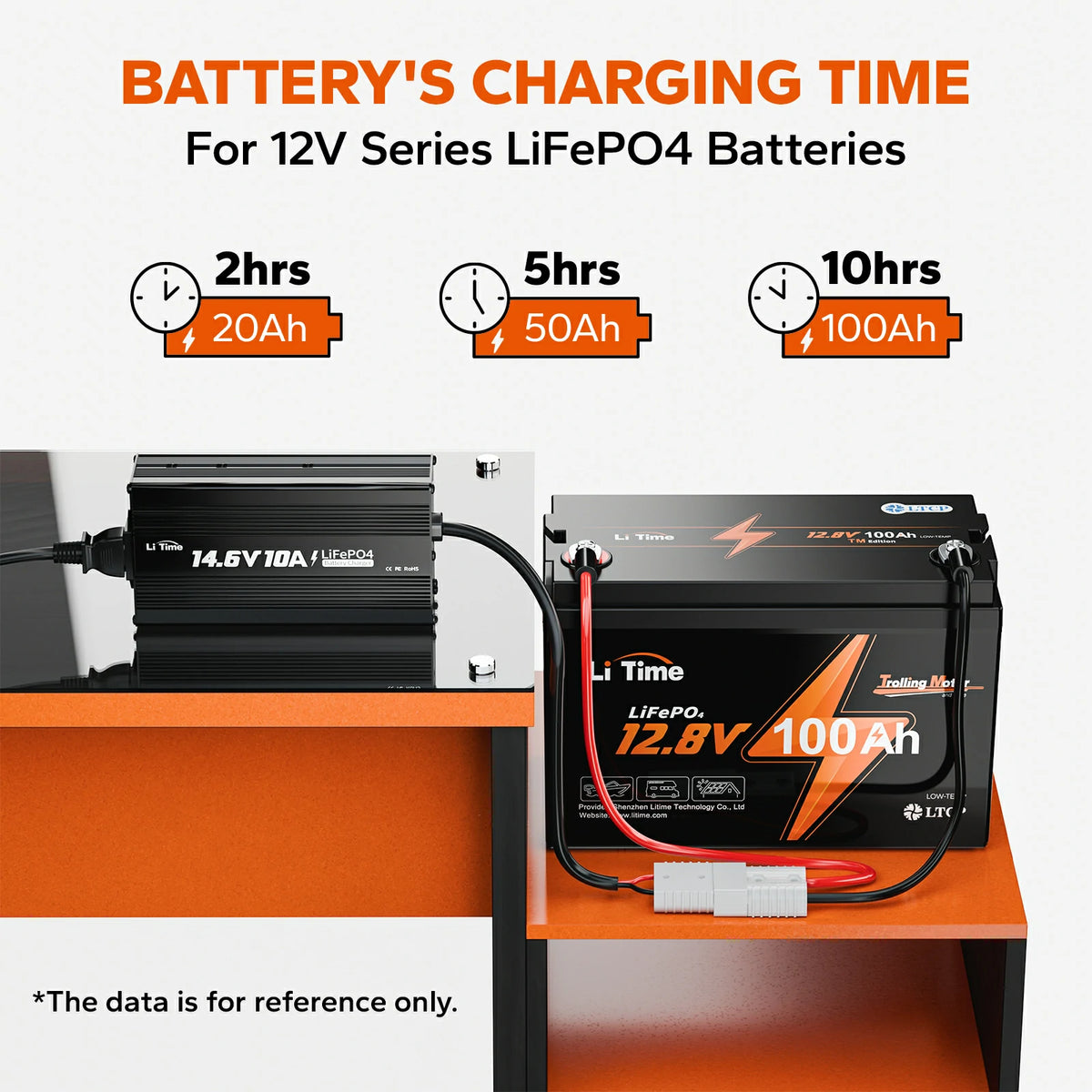
Choose a charger that matches the finished bank's voltage, battery type, and allowed charge current.
- Series bank. Use a 24V charger with the right profile for a two-battery 24V bank. Check the maker's advice on watching each battery's voltage or charging them apart if they drift out of balance.
- Parallel bank. Use a 12V charger with the right profile for the combined bank. A 12V charger can still work if you add a second battery. However, the larger battery bank may take longer to recharge at the same current. If several chargers can run at once, check their total output against the bank's allowed current.
For LiFePO₄, use the charge voltages listed in the battery manual. Set charge limits to match the batteries and the system hardware.
How Many 12V Batteries Can You Connect in Series or Parallel?
The limit depends on the exact model. Check its series limit, parallel limit, and approved combined setup before you buy or add batteries. The series limit of a lithium battery also depends on its BMS.
For example, the LiTime 12V 100Ah deep-cycle LiFePO₄ battery supports up to 4S4P. That means four batteries per series string and four equal strings in parallel, for up to 16 batteries and a rated 51.2V 400Ah bank. Use this limit for the linked model and check the manual for any other model you are looking at.
FAQs About 12V Batteries in Series vs Parallel
Is it better to hook up batteries in series or parallel?
Use series when your equipment needs a higher voltage. Use parallel when your equipment already runs on 12V and you want more capacity at that voltage.
Do 12V batteries last longer in series or parallel?
With the same batteries and the same load in watts, stored energy is the same, so runtime should be about the same. Actual runtime depends on battery capacity, conversion losses, and the discharge cutoff. Compare energy in Wh across voltages.
Can you run batteries in parallel and series at the same time?
Yes, if the battery maker approves the setup. For example, with four matching 12.8V 100Ah batteries, make two series strings of two batteries each. Then connect the two equal-voltage strings in parallel to get 25.6V 200Ah. Follow the maker's diagram for string protection and connections.
Do I need a battery balancer for parallel batteries?
You usually do not need a separate battery balancer for a bank made of matched batteries wired only in parallel. Make sure the batteries are in the right condition before you connect them. Use balanced wiring so they share current evenly. For LiFePO₄, the internal BMS handles cell balancing inside each battery where supported. In a series or series-parallel bank, follow the maker's advice for balancing the batteries.
Can you trickle charge two batteries in parallel?
For compatible lead-acid batteries, you can use a regulated 12V maintainer approved for the bank's combined capacity. A low-current maintainer may take a long time to recharge a depleted bank. For LiFePO₄, use a lithium-safe charger and follow the maker's storage steps. Use maintenance mode only if the maker allows it.