The best trolling motor battery for 80 lb thrust matches your motor’s voltage, current requirements, and planned runtime. For compatible 24V motors, LiTime’s 24V 100Ah Group 31 Marine battery is a good choice for greater runtime reserve, and the 24V 60Ah Group 24 Bluetooth battery offers a compact alternative. Two compatible 12V 100Ah batteries in series provide another option. Choose capacity around actual motor use, then check fit, charging compatibility, and manufacturer guidance.
Best LiTime Batteries for 80 lb Thrust Trolling Motors
Our recommended setups cover three needs: longer runtime, compact installation, and an existing two-battery layout. Each supplies a 24V-class system, but capacity and installation requirements differ. These are specification-based recommendations, not results from a comparative on-water test.
| Battery setup | Capacity | Best suited to |
|---|---|---|
| 24V 100Ah Group 31 Marine | 100Ah | Longer operation and more reserve |
| 24V 60Ah Group 24 Bluetooth | 60Ah | Limited space and intermittent use |
| Two 12V 100Ah TM Plus in series | 24V-class 100Ah | Existing two-battery layouts |
LiTime 24V 100Ah Group 31— For Longer Trips and More Runtime Reserve
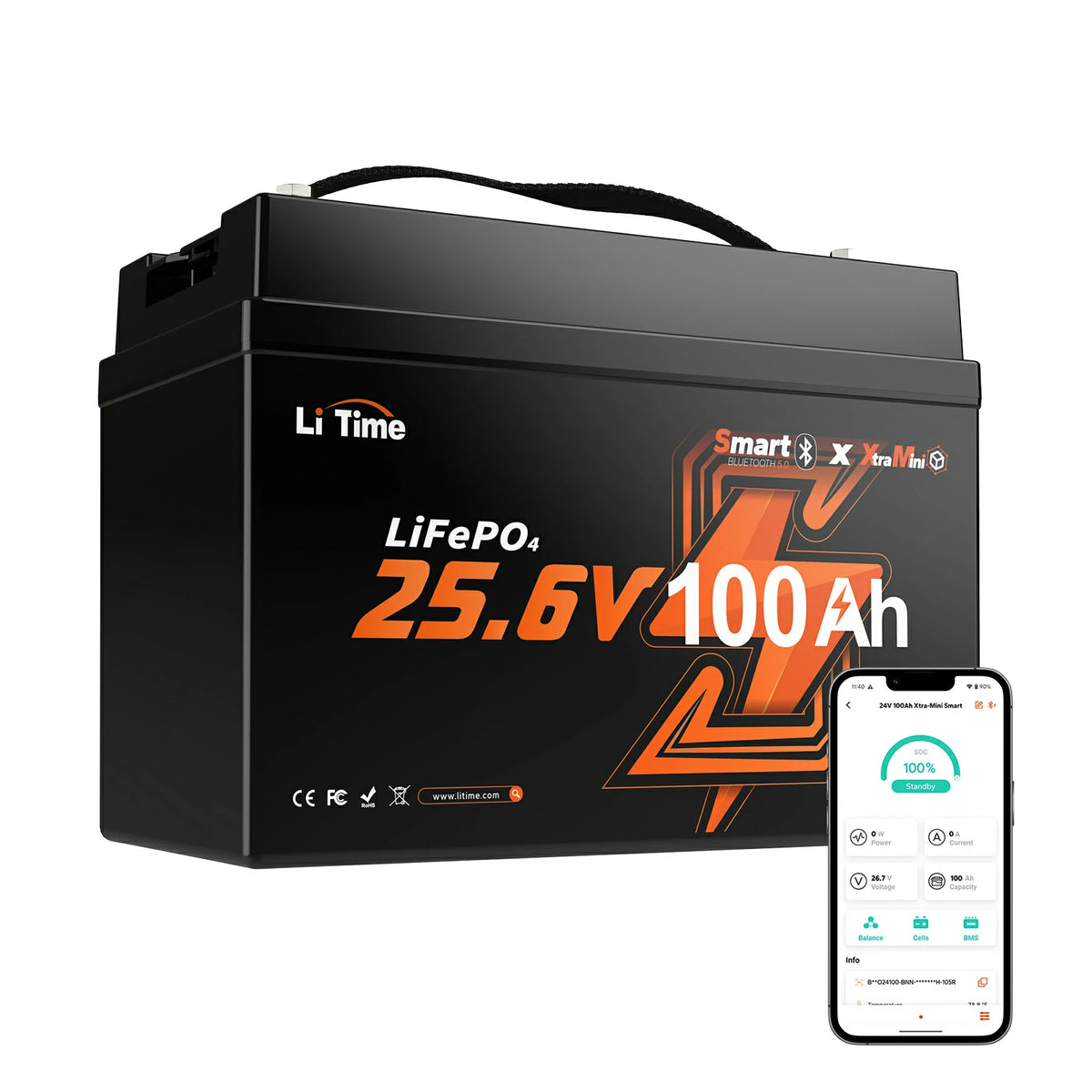
If you spend extended periods trolling, frequently use GPS anchoring, or want extra reserve for changing wind and current, the LiTime 24V 100Ah Group 31 Marine battery is our first recommendation. Its 2,560Wh capacity provides more stored energy than a 60Ah option, while its 100A continuous discharge rating supports compatible motors within that current limit.
A single 24V battery simplifies the system by replacing two series-connected 12V batteries. Bluetooth monitoring helps you check remaining charge during a trip, making it easier to plan motor use and retain a return reserve.
Best suited to anglers who prioritize runtime over the smallest possible installation. Actual endurance depends on average current and cumulative operating time; a longer fishing trip does not necessarily mean continuous motor operation.
If you also need a compatible charger, pair the battery with the LiTime 24V 20A waterproof charger. Its 29.2V output, IP67 enclosure, and mounting bracket make this a practical battery-and-charger setup for a marine installation.
LiTime 24V 60Ah Group 24 Bluetooth — For Limited Space and Intermittent Use
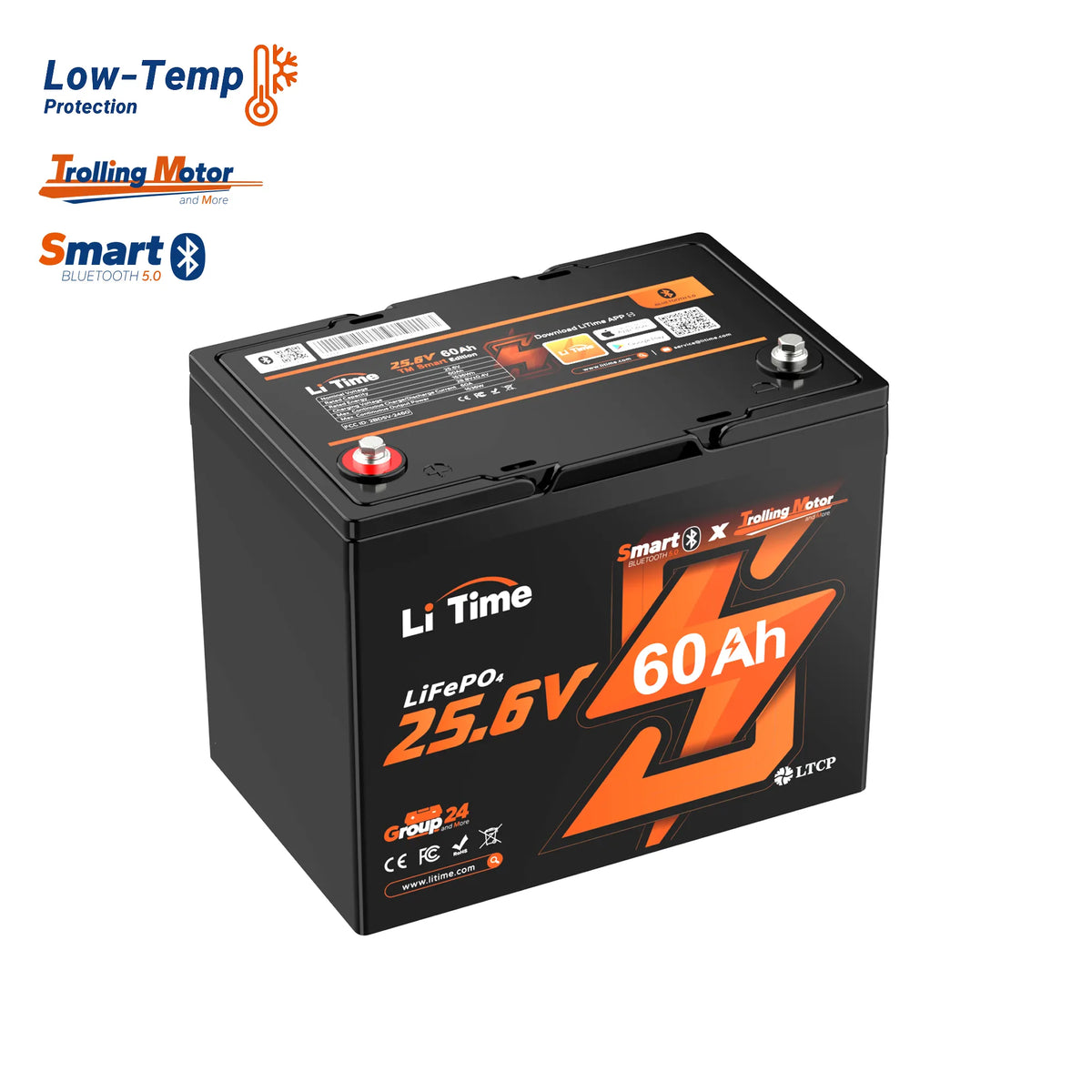
If your battery compartment is tight and your motor mainly handles intermittent positioning or short-distance adjustments, consider the new LiTime 24V 60Ah Group 24 Bluetooth battery. Its compact format supplies 1,536Wh with 60A continuous discharge, providing a single-battery alternative when those ratings meet your motor’s requirements.
Bluetooth 5.0 lets you check state of charge, voltage, and current in the LiTime App. That visibility helps you understand consumption during representative trips and judge whether the smaller capacity suits your routine.
Choose it when compact installation matters and your calculated energy demand fits within 60Ah with a suitable reserve. It is not limited to small boats or short outings: intermittent operation may stretch over a longer trip, while sustained high loads can drain the available capacity much faster.
Compared with 100Ah, the main tradeoff is less runtime reserve. Check continuous and transient current requirements separately from capacity, and measure your compartment before purchasing.
Two LiTime 12V 100Ah Batteries — For an Existing Two-Battery Layout
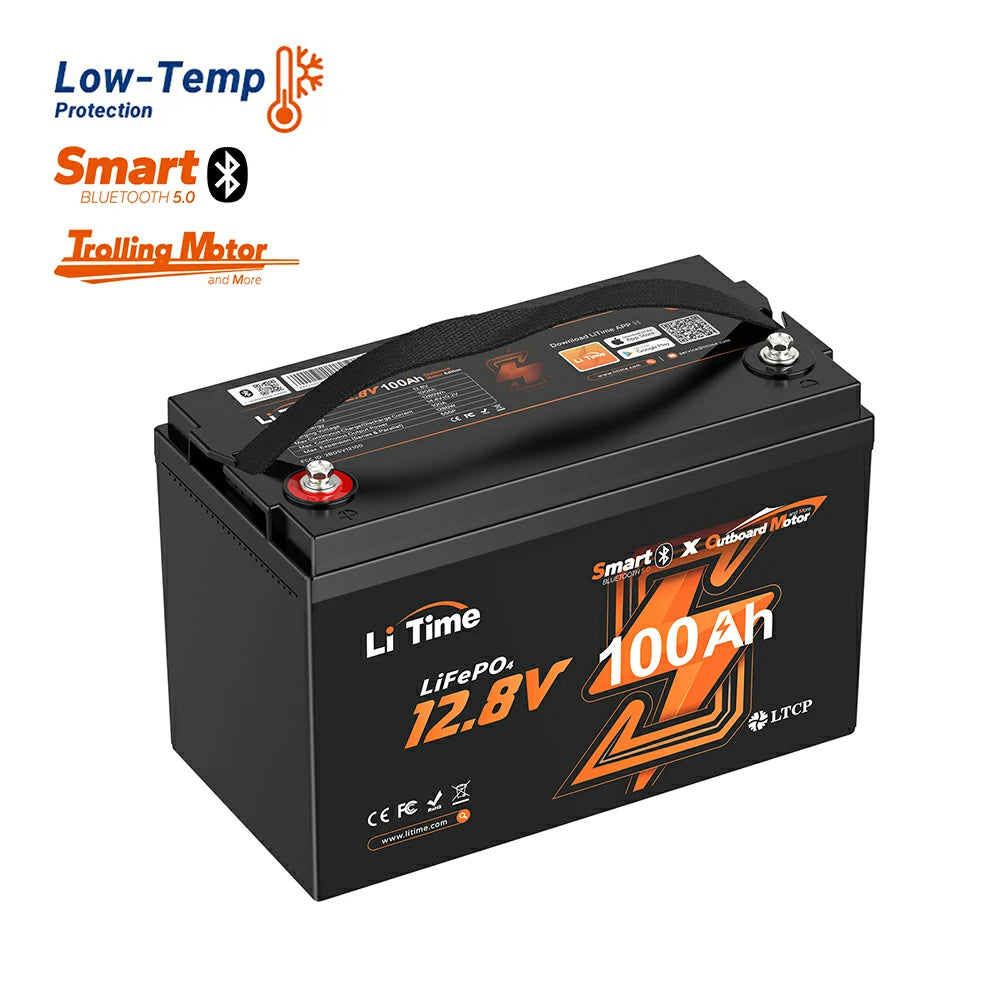
If your boat already has two separate battery positions, two LiTime 12V 100Ah TM Plus/OBM Bluetooth batteries offer a way to retain that layout. The product supports series expansion, allowing matching units to form a 24V-class system when connected according to the manufacturer’s instructions.
Together, they create a 24V-class, 100Ah bank—not 200Ah. Choose this option for installation flexibility rather than an assumed runtime advantage over one 24V 100Ah battery, and confirm the matching, wiring, and charging requirements before installation.
What Voltage Does an 80 lb Thrust Trolling Motor Need?
Common 80 lb thrust trolling motors use a 24V system, but your motor’s manual determines the required voltage.
For a 24V motor, the usual choices are one 24V battery or two compatible 12V batteries connected in series. A single battery simplifies connections; two batteries may suit an existing layout. Connecting two 12V batteries in parallel still produces a 12V system.
LiFePO4 product names commonly use “12V” and “24V,” although the batteries discussed here have nominal voltages of 12.8V and 25.6V. Confirm lithium compatibility as well as the voltage class.
Minn Kota claims that its conventional 80 lb configuration is at 56A maximum draw with a 60A breaker at 24V. Use the applicable model instructions for breaker selection and cable sizing.
How Many Amp-Hours Do You Need: 60Ah or 100Ah?
Choose amp-hours from average current and cumulative motor operating time, with an allowance for reserve. Ah measures capacity; A measures current. A battery must provide both enough stored energy and sufficient continuous discharge current.
Use this planning formula:
Required capacity (Ah) = Average current (A) × Operating time (hours) ÷ Planned usable fraction
For example, an assumed 20A average over four operating hours requires 80Ah of use. If you plan to retain a 20% reserve, divide by 0.8: 20 × 4 ÷ 0.8 = 100Ah. The reserve is a planning choice, not a fixed LiFePO4 discharge limit.
When Is 60Ah Enough?
A 60Ah battery is enough when calculated use fits within your chosen capacity budget. With a 20% reserve, that budget is 48Ah; an assumed 12A average for three hours uses 36Ah.
This may suit intermittent maneuvering and lower cumulative operating time. Use observed current when available, rather than assuming a particular speed setting always draws the same amperage.
When Is 100Ah the Better Choice?
Choose 100Ah when longer operation or higher average demand exceeds the smaller battery’s budget. Extra reserve also helps when wind or current increases unexpectedly. For a bass boat relying heavily on its motor for positioning, build your estimate around those conditions.
How Long Will a 60Ah or 100Ah Battery Run Your Motor?
At an assumed average draw of 20A, a 24V 60Ah battery provides about 3 hours of theoretical runtime, while a 24V 100Ah battery provides about 5 hours. Planning to retain 20% capacity reduces these estimates to 2.4 and 4 hours, respectively.
Our guide to how long a 100Ah battery will run a trolling motor explains the basic calculation:
Theoretical runtime (hours) = Battery capacity (Ah) ÷ Average current draw (A)
For trip planning, include your chosen reserve:
Planned runtime (hours) = Battery capacity (Ah) × Planned usable fraction ÷ Average current draw (A)
The following estimates use an 80% capacity budget, leaving 20% reserve. This is a planning assumption, not a fixed LiFePO4 discharge limit or a measured runtime guarantee.
| Assumed average current | 24V 60Ah: 48Ah budget | 24V 100Ah: 80Ah budget |
|---|---|---|
| 10A | 4.8 hours | 8 hours |
| 20A | 2.4 hours | 4 hours |
| 30A | 1.6 hours | 2.7 hours |
| 56A | 0.86 hours | 1.43 hours |
The 56A row represents a high-load example for certain 80 lb motors. These current values do not correspond to fixed speed settings; use your motor’s specifications and observed consumption.
Actual runtime varies with speed, boat load, wind, current, and additional devices sharing the battery. A six-hour fishing trip may involve much less than six hours of motor operation. Track current and remaining charge during representative trips to judge whether 60Ah covers your needs or 100Ah provides useful extra reserve.
Lithium vs. Lead-Acid for 80 lb Thrust Trolling Motors
LiFePO4 is worth considering when weight, usable energy, and reduced maintenance matter. Lead-acid may remain practical when upfront cost dominates and the existing system already meets your needs.
| Consideration | LiFePO4 | Lead-acid, including AGM |
|---|---|---|
| Weight | Typically lighter for comparable stored energy | Typically heavier |
| Capacity planning | Can support deeper use within manufacturer limits | More sensitive to deep cycling and high discharge rates |
| Charging | Requires a compatible lithium profile | Requires the appropriate lead-acid profile |
| Maintenance | No electrolyte topping up | AGM needs no topping up; flooded types may need it |
| Initial cost | Often higher | Often lower |
For a closer comparison, explore our AGM vs. lithium batteries guide before deciding whether to upgrade your existing setup.
Whichever chemistry you choose, use a deep-cycle battery for sustained trolling motor operation. Our starting battery vs. deep-cycle battery guide explains why starting batteries serve a different purpose.
FAQs
Can These Batteries Also Power a 70 lb Thrust Trolling Motor?
They can be considered for compatible 24V 70 lb motors when current requirements fall within the selected battery’s ratings. Confirm continuous and transient demand, lithium compatibility, and charging requirements. A lower thrust rating does not automatically determine how long a particular battery will last.
Does a Higher-Ah Battery Increase Motor Thrust?
Higher Ah mainly increases available runtime at a given load. It does not raise the motor’s rated thrust. Adequate current delivery and correct voltage help the motor operate as intended, but increasing capacity should not be confused with upgrading the motor’s power rating.
Do I Need a New Charger When Switching to Lithium?
Only if your existing charger does not meet the battery’s voltage and charging-profile requirements. Check its manual for explicit LiFePO4 support. For a two-battery series bank, review the charging arrangement carefully; our guide to charging batteries in series provides additional background.
Choose the 24V 100Ah Group 31 Marine battery for greater runtime reserve, or explore the new 24V 60Ah Group 24 Bluetooth option when compact installation and calculated demand align. Match the battery to your motor and your fishing routine, then confirm mounting and charging before heading out.